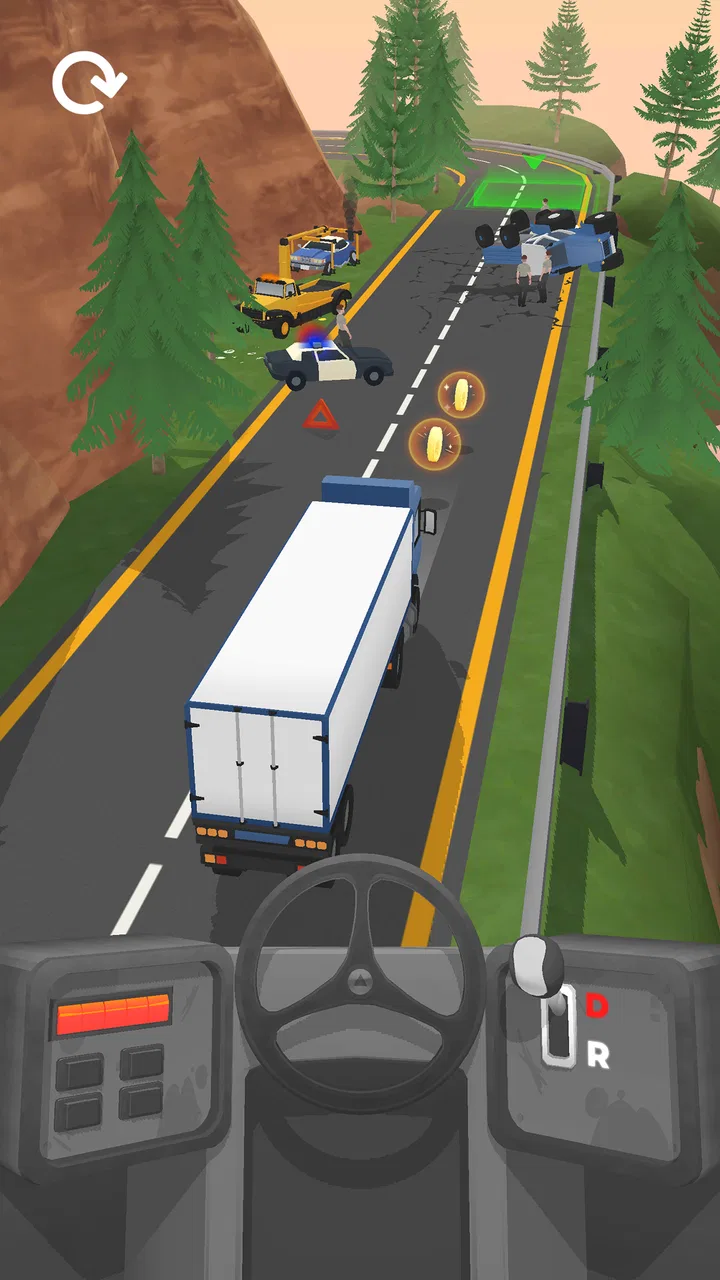
Vehicle Masters
- 4.5
- Rating
- 100.00M
- Installs
- Free
- Price

 Analysis by App-foxy
I approached Vehicle Masters expecting a quick driving game, but its appeal is a little more specific: it turns everyday vehicle situations into short simulation challenges. Instead of asking me to race around a track, it puts the focus on handling different vehicles and reacting to practical driving moments. That makes it easy to start, yet it also gives the game a more relaxed identity than a traditional racing title.
As a free simulation game from SayGames Ltd, it is clearly designed for people who want something they can pick up without a long tutorial or a complicated commitment. The age rating is Everyone, and the game has become a very widely played mobile title, with over 100 million installs and an average rating of 4.4 from around 1.4 million ratings. Those figures do not automatically make a game good, but they do match my impression that this is an accessible experience aimed at a broad audience.
What to expect when you start playing
The first important thing to understand is that Vehicle Masters is not trying to replace a full driving simulator. I would not install it expecting detailed vehicle tuning, a realistic open-world map, or the depth of a dedicated racing game. Its strength is the opposite: it reduces driving situations to manageable tasks that are easy to understand on a phone.
In-Depth Coverage of Vehicle Masters
The store’s short description calls it “Vehicle Masters,” while the longer summary points toward a large collection of vehicles and driving situations. In practice, that idea is more useful than treating the game as one continuous road trip. I found myself approaching each situation as a small problem to solve. The vehicle, the surroundings, and the required movement matter more than raw speed.
That structure makes the game suitable for short breaks. I could play when I had only a few minutes, finish a situation, and put the phone away without feeling that I had abandoned a long race or interrupted a complicated campaign. It also works well for younger players and casual users who may find conventional racing controls too demanding.
There is a trade-off here. Players who enjoy competition, lap times, online rivalry, or deep mechanical realism may find the experience too controlled. The satisfaction comes from completing the task in front of me, not from mastering a professional racing circuit. This is a situation-based driving game first, not a serious motorsport simulator.
The right mindset for the vehicle challenges
I had better results when I stopped treating every level as a race. The natural instinct on mobile is to press forward and look for the fastest route, but the game is more enjoyable when I pay attention to positioning and timing. A vehicle that feels easy in an open space can become awkward when I need to maneuver carefully.
That change in mindset is one of the first useful lessons for a new player. If a task seems unexpectedly difficult, rushing is usually not the best response. I slow down, observe the available space, and make smaller movements. This is especially helpful on a phone, where a brief overcorrection can send the vehicle away from the intended line.
The variety of vehicles also gives the game some of its personality. I do not approach every challenge with exactly the same expectations. A larger vehicle may require more patience, while a more compact one can feel more forgiving when space is limited. Even without turning the game into a technical simulator, those differences make the challenges feel less interchangeable.
Getting through the first setup without overthinking it
Installation is straightforward for compatible devices, since the game requires Android 8.0 or later. It is free to download, so the initial decision is simple: install it, open it, and see whether its short driving challenges suit your taste. The current version is 1.0.47, which is the version I would look for when checking that I am using the up-to-date release.
I would not spend time searching for advanced settings before playing. The best first setup is practical: make sure the screen is comfortable to hold, use a stable connection if the game requests one during normal use, and begin with the default control approach. New players often make things harder by trying to optimize everything before they understand how the vehicles respond.
The free-to-play model is worth keeping in mind from the beginning. In-app purchases range from $1.99 to $14.99 per item. I see that as a reason to establish a personal rule before playing: enjoy the opening experience without assuming that every optional purchase is necessary. A free download can still encourage spending, so I prefer to decide in advance whether I am willing to buy anything.
For a child using the game, I would set that expectation with an adult before handing over the phone. The Everyone rating makes the title broadly accessible, but age suitability and spending habits are separate questions. The game can be appropriate for a family device while still benefiting from sensible purchase controls.
Your first meaningful success
The first success I look for is not simply reaching the end of a task. It is completing a driving situation while staying in control instead of relying on frantic corrections. That may sound modest, but it gives a new player a useful feel for the game. Once I can guide the vehicle deliberately, later situations become easier to read.
My advice is to use the opening challenges as a control lesson. Test how much movement is needed for a turn, notice how quickly the vehicle reacts, and avoid holding a direction longer than necessary. On a touchscreen, small inputs are often more useful than dramatic swipes or repeated corrections.
You May Also Like

 Lords Mobile: Kingdom Wars
Lords Mobile Is a Kingdom-Building Routine, Not a Quick Match
A case-by-case verdict on the building, battles, device demands, and social commitments that make Lords Mobile rewarding for some players and exhausting for others.

 PDF Scanner app - TapScanner
TapScanner Makes Paperwork Easier to Capture, Check, and Share
TapScanner makes scanning with a phone feel less like a rescue operation and more like a dependable step in getting work done. Its capture tools are useful, though not flawless.

 Block Blast!
 Shows How Much a Puzzle Game Can Leave Out
A quiet grid game shows why puzzle players increasingly value instant clarity, repeatable skill and low-pressure play—and where the genre still needs to catch up.

 Family Space
 Review: A Shared Routine That Makes Family Life Easier
A parenting app earns its place not by adding more noise, but by making everyday coordination easier. Family Space gets that balance mostly right.

 1Weather Forecasts & Radar
 Makes the Daily Check Worthwhile
A good forecast does more than predict rain. This week's pick turns changing conditions into a clear, practical reason to check before you step outside.

 Clash of Clans
 Makes Patience Part of the Strategy
A village builder with a sharp tactical core, Clash of Clans turns patience into momentum and each raid into a small, satisfying act of judgment.
More From Our News Desk
View All News


A practical routine is to pause mentally before each maneuver. I look at where the vehicle needs to end up, choose the broadest safe line, and then move in stages. This is more reliable than trying to improvise every second. It also makes the game feel less random, because I can tell whether a mistake came from poor timing, a bad angle, or simply moving too aggressively.
That approach is particularly useful in an everyday scenario. Imagine opening the game during a commute or while waiting for an appointment. You may not have the attention for a long race, but you can focus on one compact challenge, finish it, and stop. If the first attempt goes wrong, the short format makes retrying feel manageable rather than exhausting.
Why players may initially find the controls confusing
The most common confusion is expecting familiar racing-game behavior. In a racing title, acceleration and steering are usually the main concerns, and the goal is often to maintain speed. Here, the situation itself matters more. A player who keeps thinking about speed may miss the importance of careful alignment and controlled movement.
Another source of friction is judging distance on a small screen. I sometimes felt that I had enough room, only to discover that the vehicle’s position was less forgiving than it looked. When that happens, I recommend making the camera and the vehicle’s orientation your reference points rather than relying on a quick glance at the destination.
It is also easy to interpret a failed attempt as a sign that the controls are bad. Sometimes the issue is actually the chosen approach. If I enter a tight area too quickly, no control scheme will completely rescue the maneuver. Slowing down before the difficult section gives me more time to correct the line and makes the result feel more consistent.
That said, the game is not frictionless. Touch controls can feel imprecise when I am trying to make a very small adjustment, and players who prefer physical buttons may need a short adaptation period. The simplicity that helps beginners also means there is less room for fine control than in a dedicated simulator.
How to make progress without turning it into a chore
Once the basic controls feel familiar, I suggest treating each new vehicle as a fresh handling exercise rather than assuming the previous solution will work everywhere. I take a moment to notice how much space I have and whether a wide, patient movement is safer than a direct one. This small habit prevents many avoidable failures.
One of the more useful non-obvious strengths is that the game rewards observation before action. It is tempting to start moving immediately, especially when the challenge looks simple. Waiting briefly to understand the route can save more time than it costs. That is a good lesson for anyone who tends to overcorrect on touchscreen games.
A second useful habit is to separate progress from perfection. I do not replay every completed situation just because the first attempt was untidy. If I completed the task and understood what worked, I move forward. Replaying makes sense when I am trying to improve my control or when a particular vehicle exposes a weakness in my technique, but it is not necessary for every stage.
A third trade-off concerns spending. Optional purchases may be convenient for players who want to move through the game more quickly, but the core appeal is strongest when I treat the challenges as practice rather than obstacles to bypass. If I am enjoying the act of learning each vehicle, spending to remove that process would reduce some of the reason I installed the game.
Where it fits among other driving games
Compared with arcade racers, Vehicle Masters is less about speed and competition. A racing game is the better choice when I want dramatic tracks, overtaking, lap-based goals, or a strong sense of rivalry. This title is better when I want a sequence of focused driving situations without committing to a full race.
Compared with realistic driving simulators, it is easier to approach but not as technically demanding. A serious simulator can be rewarding for someone who wants detailed vehicle behavior and extended practice. I would choose Vehicle Masters instead when I want the idea of driving simplified into quick mobile tasks.
It also differs from open-world driving games. Open-world titles are built around exploration and freedom, while this game gives me a more directed objective. That makes it less suitable for wandering around and creating my own stories, but more suitable when I want the game to tell me what kind of driving problem to solve next.
For families, the comparison is slightly different. The Everyone content rating and simple premise make it approachable, but the player still needs to be comfortable with the controls and the free-to-play structure. A child who enjoys vehicles but becomes frustrated by repeated positioning tasks may prefer a simpler driving game, while a child who likes figuring out how to fit a vehicle through a situation may find this one rewarding.
Who should play it, and who should skip it
I would recommend it to casual players who like vehicles but do not necessarily want racing pressure. It is also a good match for people who enjoy bite-sized tasks, visual problem-solving, and learning a control scheme through repetition. The game’s broad audience is reflected in its popularity, with around 1.4 million ratings and more than 2,000 written reviews in the store.
I would be more cautious about recommending it to someone looking for competitive depth. If your ideal driving game includes online opponents, detailed customization, realistic traffic systems, or long-form progression, this may feel lightweight. It is also not the best choice if you dislike touchscreen steering or become irritated when a small mistake forces another attempt.
Players who want a completely uninterrupted free experience should also consider the purchase model before installing. The game costs nothing to download, but optional items are available. That does not make it a poor choice, yet it does mean the experience is better suited to users who can ignore optional spending or manage it comfortably.
A practical routine for the first few sessions
For the first session, I would play until the basic movement feels predictable rather than trying to rush through as much content as possible. The goal is to learn how the game communicates a successful maneuver. Once that feels clear, I would begin paying attention to which situations cause trouble and why.
For the second session, I would focus on one weakness at a time. If I keep turning too sharply, I would make gentler inputs. If I misjudge space, I would approach the area more slowly. If I lose track of where the vehicle is pointing, I would pause before committing to the next movement. This turns failure into useful feedback instead of simple repetition.
For later sessions, I would use the game as a short reset rather than a main gaming commitment. It works well between larger activities because the challenges are easy to understand quickly. The main limitation is that its compact format may eventually feel repetitive to players who need a strong long-term goal, so I would keep expectations realistic.
My final view after spending time with it
Vehicle Masters succeeds because it makes driving situations approachable. I like that I can open it without preparing for a long race, learn through small attempts, and get a clear sense of progress from handling different vehicles. Its best moments come when I stop rushing and solve the movement in front of me with patience.
It is not a universal recommendation. The controls may frustrate players who want precision, the free-to-play purchases deserve awareness, and the simplified simulation will not satisfy fans of deep driving realism. Those limitations are important because they define the audience rather than being minor details.
For me, the strongest reason to try it is the balance between familiarity and simplicity. It borrows the recognizable pleasure of driving while removing much of the pressure found in racing games. If you want short, vehicle-focused challenges and are happy to learn through careful movement, I think it is worth downloading for free. If you want a full racing career, open exploration, or technical simulation, I would choose a different category of driving game instead.
My recommendation is to give the opening challenges a fair chance, avoid judging the controls during the first rushed attempt, and decide early whether the short-task format suits you. Once the basic handling clicks, the game becomes a pleasant way to fill a few spare minutes. Its real strength is not speed; it is making each small driving problem feel solvable.
FAQs for Vehicle Masters
01What is Vehicle Masters and what can I do with it?
Vehicle Masters is an engaging mobile game available on both Android and iOS platforms. It allows players to design, customize, and race a variety of vehicles. With a wide selection of parts and upgrades, players can unleash their creativity and compete in thrilling races, aiming to become the ultimate vehicle master.
02How does customization work in Vehicle Masters?
Customization in Vehicle Masters is a central feature that offers players an extensive array of options to personalize their vehicles. You can modify everything from the engine and tires to the paint job and decals. As you progress, additional parts and upgrades become available, allowing for deeper customization and improved performance in races.
03Is Vehicle Masters free to play, and are there in-app purchases?
Vehicle Masters is free to download and play, offering a variety of content available without purchase. However, the game includes in-app purchases that allow players to buy additional parts, currency, or cosmetic items. These purchases can enhance gameplay but are not required to enjoy the full experience.
04What are the system requirements for Vehicle Masters on Android and iOS?
For Android, Vehicle Masters requires a device running Android 5.0 or higher with at least 2GB of RAM for optimal performance. On iOS, the game requires iOS 11.0 or later and is compatible with iPhone, iPad, and iPod touch. Ensuring your device meets these requirements will provide a smooth gaming experience.
05Can I play Vehicle Masters offline, or is an internet connection required?
Vehicle Masters offers both online and offline modes. While you can enjoy single-player races and customization offline, an internet connection is necessary for multiplayer modes and accessing certain features. Connecting online also ensures you receive the latest updates and events, enhancing your overall gaming experience.
Pros
- Intuitive interface for easy navigation.
- Comprehensive vehicle customization options.
- Realistic driving physics enhance gameplay.
- Regular updates with new content.
- Offline mode available for uninterrupted play.
Cons
- In-app purchases can be costly.
- Occasional lag on older devices.
- Limited tutorial for beginners.
- Ad frequency can be distracting.
- Multiplayer mode lacks stability.

Vehicle Masters
Gallery